

If Bali suddenly seems to be sprouting tall, curved bamboo poles outside homes and along village roads, Galungan is probably close. One of the most important holidays in Balinese Hinduism, it brings several days of preparation, temple visits, family gatherings and a great deal of beautifully arranged food that is very much not there by accident. The celebration marks the victory of dharma over adharma, or good over evil, and welcomes ancestral spirits back to the earthly world.
Ten days later, Kuningan brings the cycle to its conclusion. For visitors, understanding a little of what is happening makes the decorations, ceremonies and sudden bursts of activity around the island much more meaningful. This is what Galungan celebrates, how Bali prepares for it and which traditions you are likely to encounter if your trip happens to coincide with the festivities.
What Is Galungan Day in Bali?
Galungan celebrates the triumph of dharma, or righteousness, over adharma, which represents disorder and wrongdoing. But the holiday is also deeply tied to family. Balinese Hindus believe ancestral spirits return to visit their relatives during this period, so remembrance, offerings and time spent at home all play an important part in the celebration.
Unlike holidays fixed to the Gregorian calendar, Galungan follows Bali’s 210-day Pawukon calendar. That means it comes around more often than most annual celebrations, usually about twice in a Gregorian year.
In 2026, Galungan fell on Wednesday, 17 June, followed by Kuningan on Saturday, 27 June. The next cycle begins with Galungan on Wednesday, 13 January 2027, with Kuningan following ten days later on Saturday, 23 January. Galungan then returns on Wednesday, 11 August 2027, with Kuningan on Saturday, 21 August.
The Days Before Galungan and How Bali Prepares
Galungan does not simply begin on the morning of the celebration. The preparations start weeks earlier, with each stage carrying its own meaning and traditions. Tumpek Wariga, observed 25 days before Galungan, marks the beginning of the ceremonial sequence. It is traditionally a time to give thanks for plants, trees and the agricultural abundance they provide.
Three days before Galungan comes Penyekeban, when families begin preparing fruit, particularly bananas, for use in offerings. The day also carries a symbolic meaning centred on self-restraint and keeping temptation in check.
Penyajaan follows two days before Galungan, and the kitchen tends to get considerably busier. Families prepare traditional cakes and sweets using ingredients such as rice flour, coconut and palm sugar, ready for the offerings to come.
Then comes Penampahan, the day before Galungan. Families prepare dishes such as lawar, satay and babi guling, while households complete the final ceremonial preparations before Galungan itself. By this point, much of the work is done and the island is very clearly ready for the celebration.
Penjor: The Bamboo Poles That Line the Streets
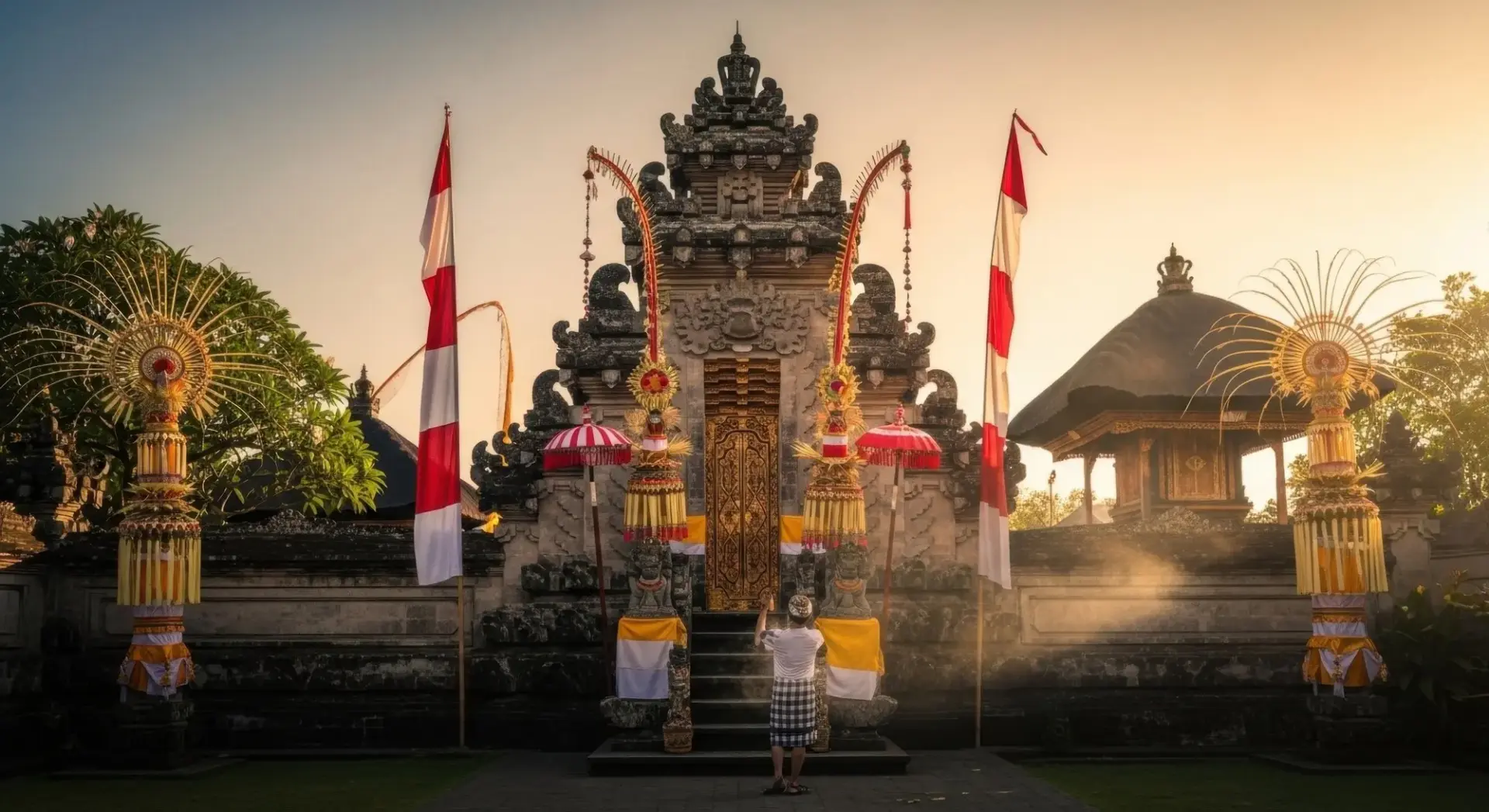
You will see penjor long before you see a ceremony. These tall bamboo poles curve over the road, usually standing five to ten metres high, and they go up outside homes, temples and village streets around Penampahan, the day before Galungan.
The curve is not just for style. Each penjor represents Gunung Agung, Bali’s highest mountain and the home of the gods. Families dress them in janur, young coconut leaf woven into delicate patterns, along with fruit, rice and other produce from the harvest. Together, they are an expression of gratitude for what the land has given.
Every household makes its own, so no two are quite the same, and the streets turn into one very long exhibition of bamboo craftsmanship. If you are riding a scooter, keep an eye on the overhang of the taller poles.
What Happens on Galungan Day
Galungan morning starts early and is mostly done before midday. Families pray at the home shrine first, then head to the family temple or village pura in their best traditional clothes. Women wear a lace kebaya with a colourful sash, and men wear a white shirt, a sarong and an udeng, the traditional headcloth.
Offerings do much of the talking. Canang sari, small palm leaf trays filled with brightly coloured flowers, are set out at shrines, doorways and gates. Each flower colour and direction is linked to a different deity, so the arrangement is never random. If you find one on the pavement, walk around it. Our guide to the traditions and culture of Bali goes deeper into what offerings mean.
After prayers, the table takes over. Extended families gather for lawar, a mix of minced meat, grated coconut and spices, alongside babi guling, the famous spit-roast pig, and urab, a vegetable salad with coconut. Relatives who live away from home often travel back for it, so Galungan works a bit like New Year for many Balinese families.
Unlike Nyepi, Bali does not shut down. Tourist restaurants and beach clubs mostly stay open, though many family-run shops close for the day and ride apps can be slow in the morning.
Visitors are welcome to watch from a respectful distance. Dress modestly near temples, keep your voice down and ask before photographing anyone who is praying. No photo is worth interrupting a prayer.
Manis Galungan and the Ten Days After
The day after Galungan is called Manis Galungan, and it is a lot softer. The big prayers are done, so families use the day to visit relatives, catch up and simply relax. Think of it as the exhale after a very busy few days.
From there, Bali moves into the stretch between the two holidays. Galungan and Kuningan are ten days apart, and that gap is filled with smaller ceremonies rather than one big event. Temples hold their own rituals, households keep their offerings fresh, and village traditions such as Ngelawang and Mekotek take over the streets in some areas.
If your trip falls inside this window, it is a good one to be here. Tourist areas run as normal, but mornings can bring slower rides and busy village roads around temples, so book drivers ahead and keep early plans flexible. You can find more Bali guides for planning the rest of your trip.
What Is Kuningan Day?
Kuningan is the closing day of the Galungan cycle. It falls ten days after Galungan, always on a Saturday, and marks the moment ancestral spirits are believed to return to the spirit world. Prayers are made to see them off, and like Galungan they are usually finished before midday.
Yellow is the colour of the day, and you will see it in nasi kuning, the turmeric rice offered at shrines, as well as in flowers and woven palm leaf decorations. Yellow stands for prosperity and gratitude, so the mood feels warm and reflective rather than loud.
Also look out for tamiang, the round, shield-like palm leaf charms placed at shrines to symbolise protection.
The next Kuningan falls on Saturday, 23 January 2027, and the one after that on Saturday, 21 August 2027.
Local Traditions That Bring Galungan and Kuningan to Life
Beyond the core rituals, many villages add their own traditions to the celebration, much like the rest of the island’s Bali festival calendar. Two of the best known are Mekotek and Ngelawang, and they could not look more different.
Mekotek in Munggu Village
Mekotek is held in Munggu Village, in Mengwi, Badung, on Kuningan Day. Hundreds of men carry long sticks of pulet wood, roughly 2.5 to 3 metres each, and bring them together into a towering pyramid. A few brave participants climb to the top. The name comes from the “tek, tek, tek” sound of wood meeting wood.
The tradition dates back to the Mengwi kingdom, when it was used to welcome warriors home from battle in East Java. Today, with wooden sticks in place of iron spears, it is performed as a tolak bala, a ritual meant to ward off misfortune and bring safety for the months ahead.
Visitors are welcome to watch. Arrive early, dress modestly and leave the climbing to the villagers. Mekotek rewards patience and punishes standing too close, because sticks do come down. The action usually starts in the early afternoon, but timing changes from year to year, so check with the village closer to the date.
The next Mekotek takes place on Saturday, 23 January 2027, and again on Saturday, 21 August 2027.
Ngelawang and the Barong Bangkung
Ngelawang is gentler. Children carry a Barong Bangkung, a barong shaped like a pig, from house to house and village to village, accompanied by gamelan. The parade is believed to chase away evil spirits and the diseases they bring, and it appears in many villages across the Galungan and Kuningan period.
If one comes down your street, step aside, enjoy the music and let the Barong pass.
Where to Unwind After the Celebrations
Many family-run shops close for Galungan and Kuningan, but Seminyak keeps going. After a morning of ceremonies, or an afternoon watching stick pyramids rise, find a table at The Forge Bali, the 24-hour gastropub in Seminyak. Check the menu before heading over, especially when the group has been on the road since early morning.